
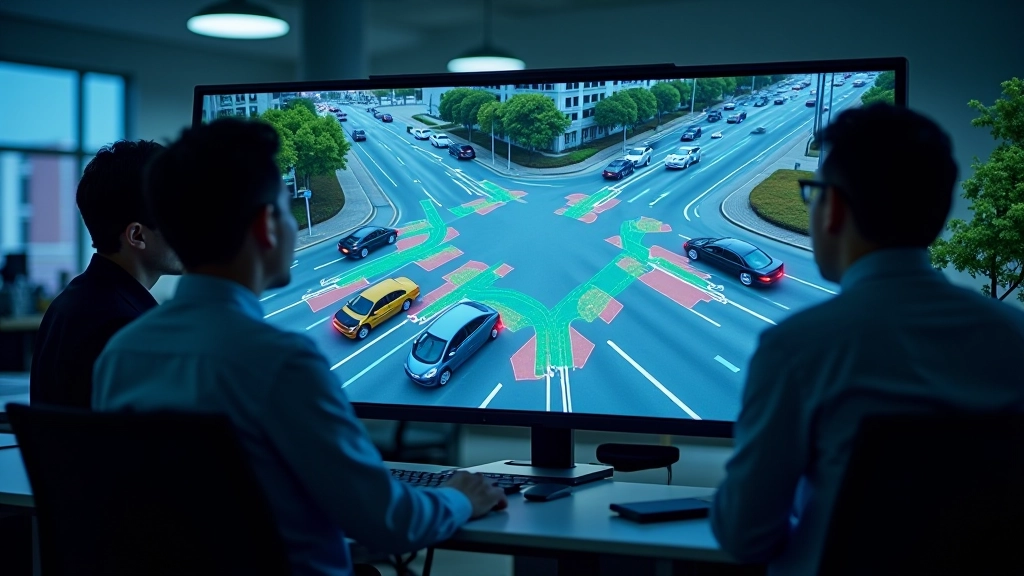
Multi-Agent Reinforcement Learning in Urban Traffic
Understand how multiple vehicles coordinate using multi-agent RL to optimize traffic flow and reduce congestion in complex urban environments.
Read Article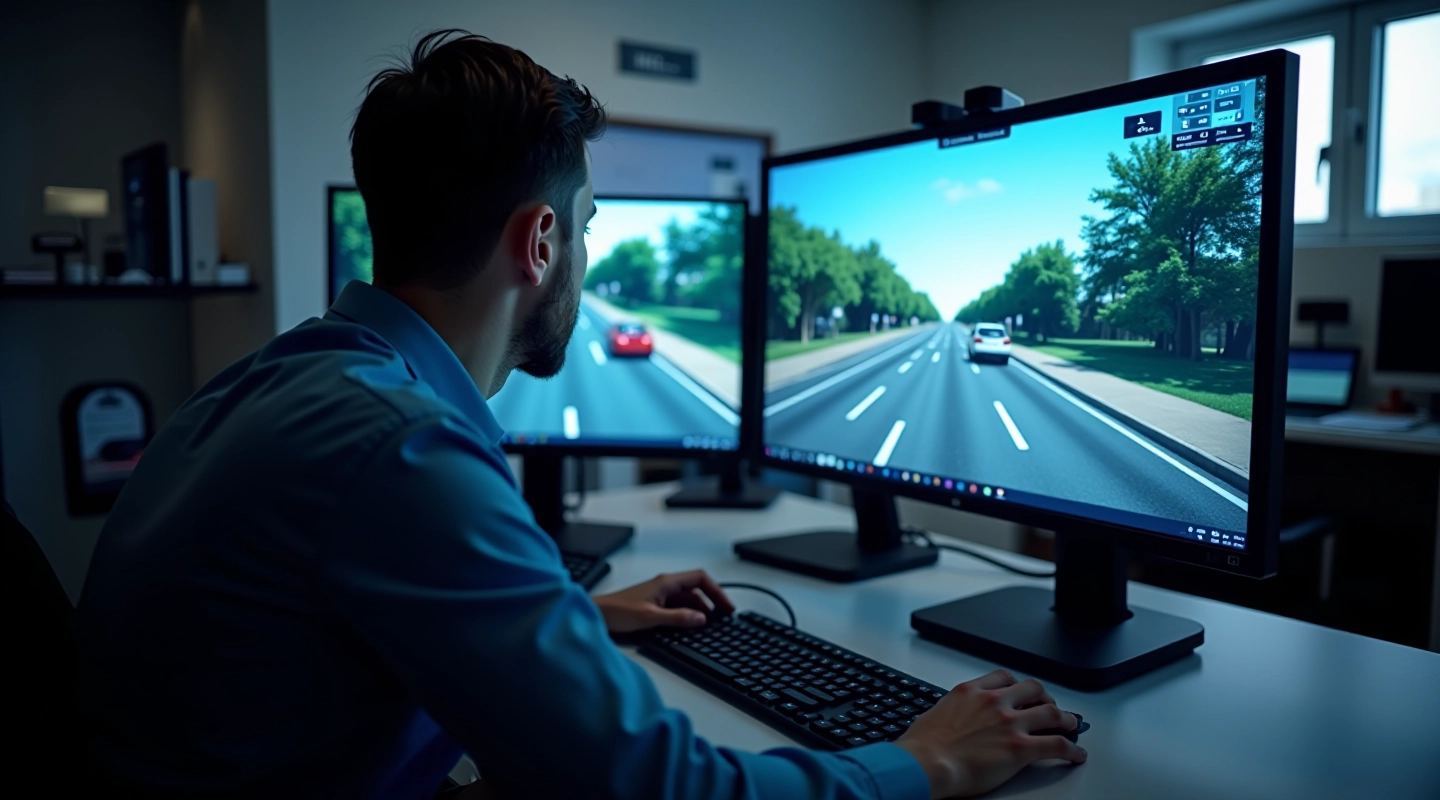
Learn how deep Q-networks train autonomous agents to make real-time driving decisions in complex traffic scenarios

Editorial Team
Written by the AutonomyLab Editorial Team, focused on practical guidance for reinforcement learning and autonomous vehicle simulation testing.
Deep Q-Learning represents a significant breakthrough in how we train autonomous vehicles to navigate unpredictable traffic environments. It's a technique that combines neural networks with reinforcement learning, allowing agents to learn driving behaviors through trial and error rather than explicit programming.
The core idea is straightforward: your autonomous agent observes its environment—other vehicles, traffic signals, road conditions—and must decide whether to accelerate, brake, or steer. Instead of hardcoding every possible scenario, deep Q-Learning lets the agent discover what actions work best by experiencing thousands of driving situations. The neural network learns to estimate the long-term value of each action, guiding decision-making toward safer, more efficient behavior.

At the heart of deep Q-Learning is something called a Q-value. Think of it as a score that represents how good a particular action is in a given situation. When your autonomous vehicle encounters a yellow traffic light with a car approaching from the side, it calculates Q-values for different actions: proceeding through the intersection, braking, or slowing down. The action with the highest Q-value gets selected.
The neural network continuously refines these Q-values through experience. In simulation, a vehicle might make a poor decision—accelerating into an unsafe scenario—and experience a penalty. That penalty gets backpropagated through the network, adjusting the weights so future similar situations trigger better decisions. Over hundreds of thousands of simulation runs, the network becomes remarkably skilled at predicting which actions lead to safe, efficient driving.

One practical challenge: driving isn't about discrete choices like "go" or "stop." Real vehicles operate in continuous spaces—you can accelerate at any value between 0 and 100%, steer at infinitely fine angles. Standard deep Q-Learning was designed for discrete actions like chess moves or video game buttons. We had to adapt.
The solution involves discretizing continuous outputs or using variants like Deep Deterministic Policy Gradient (DDPG) that handle continuous actions natively. In practice, we partition steering angles into perhaps 15-20 discrete options and acceleration into 10-15 levels. This discretization still provides smooth vehicle control—a vehicle can interpolate between these values for refined maneuvering. The network learns that slight adjustments matter: the difference between 18 degrees and 19 degrees of steering can mean successfully navigating a curve versus clipping the edge.
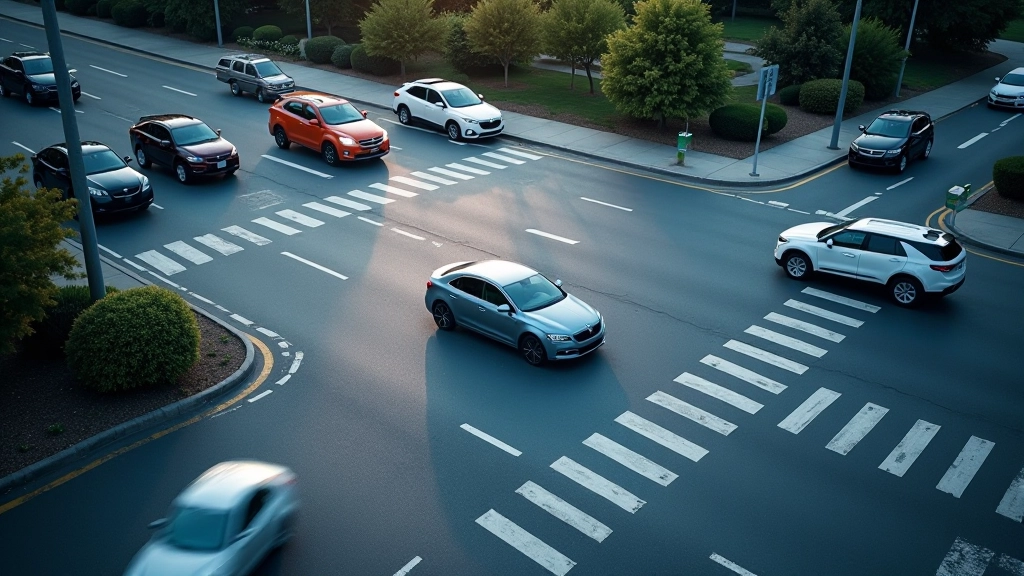
Training happens in simulation—that's the entire point. A vehicle can safely crash thousands of times in a simulator without consequences. But here's where things get interesting: the behaviors learned in simulation need to transfer to real roads. This is harder than it sounds.
Domain randomization helps bridge this gap. During training, you vary weather conditions, lighting, road textures, and sensor noise in simulation so the network doesn't overfit to perfect digital environments. A model trained on diverse, slightly degraded sensor inputs tends to generalize better to real cameras and lidars. Additionally, researchers test trained models on hold-out simulation scenarios—situations the network never encountered during training—to verify generalization before physical deployment.
"The gap between simulation and reality remains one of the biggest challenges. A model that achieves 99% accuracy on test scenarios might still encounter edge cases in real traffic that it never learned about."
Success in deep Q-Learning for driving isn't measured by a single number. Safety comes first—zero collision rate in test scenarios. Then you evaluate efficiency: average speed maintained, fuel consumption, smoothness of maneuvers. You'll also track how the agent handles edge cases like emergency stops, sudden lane changes from other vehicles, or degraded visibility.
Training typically takes weeks even on powerful hardware. A well-designed network might learn to handle highway merging in 200,000 episodes but require 2 million episodes to reliably handle dense urban traffic with unpredictable pedestrians. Episode length matters too—longer episodes where the agent must make sustained good decisions are more challenging than short bursts of driving. The best trained models show consistent behavior across varied conditions without erratic decisions or sudden failures.
Deep Q-Learning isn't a silver bullet for autonomous driving, but it's proven remarkably effective for training agents that handle real-world complexity. By learning from experience rather than following pre-programmed rules, these networks develop intuitive driving behaviors that generalize across scenarios. The technique combines the pattern-recognition power of neural networks with the goal-directed learning of reinforcement learning, creating systems that improve continuously as they encounter new situations.
The field is evolving rapidly. Researchers are exploring multi-agent deep Q-Learning where vehicles coordinate behavior, hierarchical approaches that handle both strategic planning and tactical control, and hybrid methods that blend deep Q-Learning with other techniques. If you're working on autonomous vehicle simulation or testing frameworks, understanding these fundamentals gives you the foundation to evaluate, implement, and improve deep Q-Learning-based systems.
Individual learning outcomes vary from person to person. This article provides educational information about deep Q-Learning concepts and their application to autonomous vehicle simulation. Practical implementation results depend on specific simulation environments, reward design, network architecture, and training parameters.
Explore related topics in reinforcement learning and autonomous vehicle testing
Understand how multiple vehicles coordinate using multi-agent RL to optimize traffic flow and reduce congestion in complex urban environments.
Read Article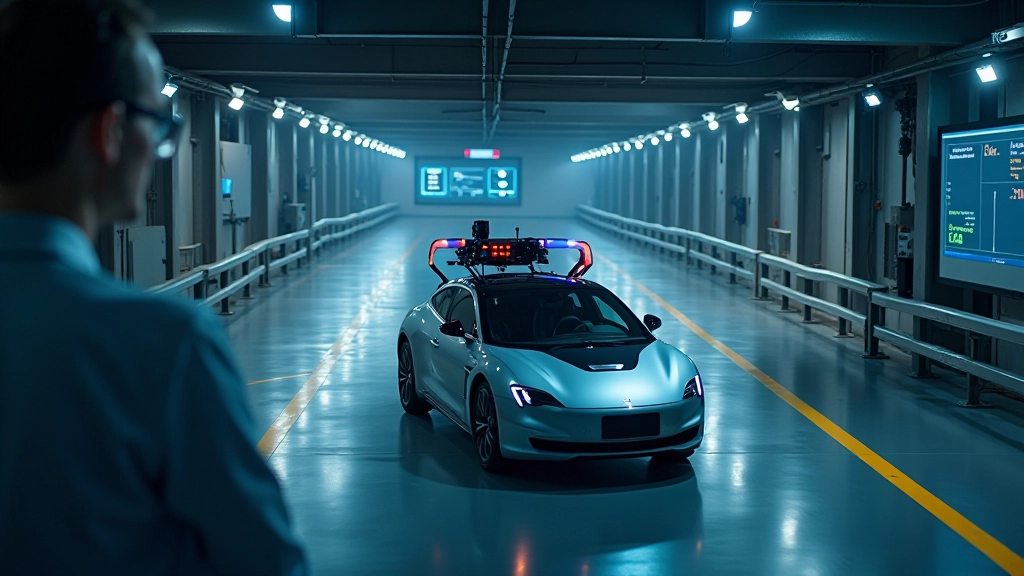
Explore validation methodologies and safety benchmarks used to certify autonomous vehicle systems for real-world deployment.
Read Article
Discover how actor-critic methods and policy gradients enable smooth steering and acceleration control in autonomous driving systems.
Read Article